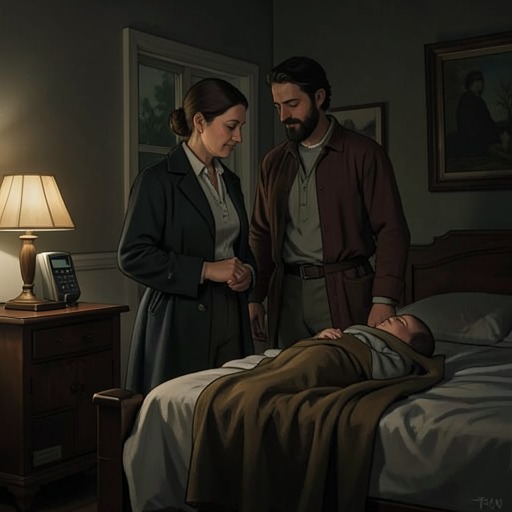
James—I Ibai: father and son
Legado en los huesosJames’s fatherhood of Ibai begins in a scene of shared awe and becomes visible in the ordinary demands of newborn care. His tenderness toward his son and his attentive partnership with Amaia Salazar make their bond more than a moment of birth: it is a relationship formed through presence, sleeplessness, and practical choices.
Birth and First Recognition
When Amaia realizes that the baby is a boy, James reaches out to touch the child’s soft cheek. He calls the birth wonderful, his voice breaking as he leans down to kiss Amaia; tears have run down his face. Their exchange of congratulations makes the arrival a shared family event, and James addresses the newborn as his son. The scene establishes affection before it establishes any account of what kind of father he will be: his first response is physical tenderness and emotion.
Care in the First Nights
That tenderness continues after the delivery room. During one quiet visit with Engrasi, James has fallen asleep on the sofa after a night in which the family has barely rested. Ibai suffers from colic during some feeds, especially at night, and James has spent the hours walking around the house with the baby in his arms. Engrasi calls him a good father; Amaia answers that he is the best. The praise is grounded in a particular form of care: James takes the child through the difficult nighttime hours, even when the work leaves him exhausted.
The domestic details place fatherhood in a shared household routine. As Engrasi sings, Amaia covers the sleeping James with a red blanket; he opens his eyes briefly, sends her a kiss, and falls asleep again. Engrasi then watches Ibai and passes him to Amaia. James’s presence in this scene is quiet rather than ceremonial, but his fatigue records the care he has already given, while Amaia’s praise confirms that she sees him as an active and loving parent.
Feeding, Work, and Parental Pressure
James also raises the practical strain involved in continuing breastfeeding. He tells Amaia that the demands of its schedule may not be compatible with her work and suggests that she seriously consider stopping and moving fully to bottle-feeding. The suggestion is framed around the constraints she faces, not as a judgment of her devotion to Ibai.
Amaia’s inward response reveals how heavily she experiences the decision. She wants to do motherhood well for Ibai, but also for the frightened child she once was; she fears that any failure would make her a bad mother like her own. Her exhaustion and sense of failure sit beside the ideal of maternal happiness she expected. The passage therefore shows James engaging with the practical conditions of parenting while Amaia struggles with the inherited fear that those conditions might expose something bad in herself. The evidence establishes his proposal, but not what decision she ultimately makes about feeding.
Family History and the Meaning of Protection
The relationship unfolds against revelations about the family Amaia came from. She recounts how Rosaura, as a child, secretly moved into Amaia’s bed after Rosario came to the wrong bed believing Amaia was there and made a terrifying remark. Rosaura says she returned to Amaia’s side out of fear and thereafter let her sleep beside her. Amaia tells her sister that neither girl could have understood or controlled what was happening, but identifies their father as the adult who should have protected her and did not. She recalls being sent away from home while Rosario was protected.
This remembered failure gives James’s care for Ibai a resonant contrast: the book shows him holding and tending to his son, while Amaia names the absence of protection that marked her own childhood. The contrast does not erase the complexity of new parenthood—Amaia’s doubts remain real—but it clarifies the importance of James’s concrete participation. His fatherhood is expressed not as an abstract ideal, but through touch at the birth, hours carrying a colicky baby, and attention to the practical pressures shaping the family’s care.